
Legal Notice Format India — 8 Free Samples (PDF & Word) + Hindi Format
A legal notice in India follows a standard structure: letterhead, date, recipient's address, subject, facts, the law that applies, a specific demand with a deadline, the consequence of non-compliance, and a signature. Below is a general format you can use for any dispute, seven formats for specific disputes, and a Hindi format — all free to download as PDF or Word.
vakiltech Legal Team
Reviewed by a vakiltech panel advocate
General Legal Notice Format (Any Dispute)
Start hereA universal format that works for most civil disputes. Fill in the brackets with your facts, cite the law that applies, and state one clear demand with a deadline. For a specific dispute, use the matching format further down.
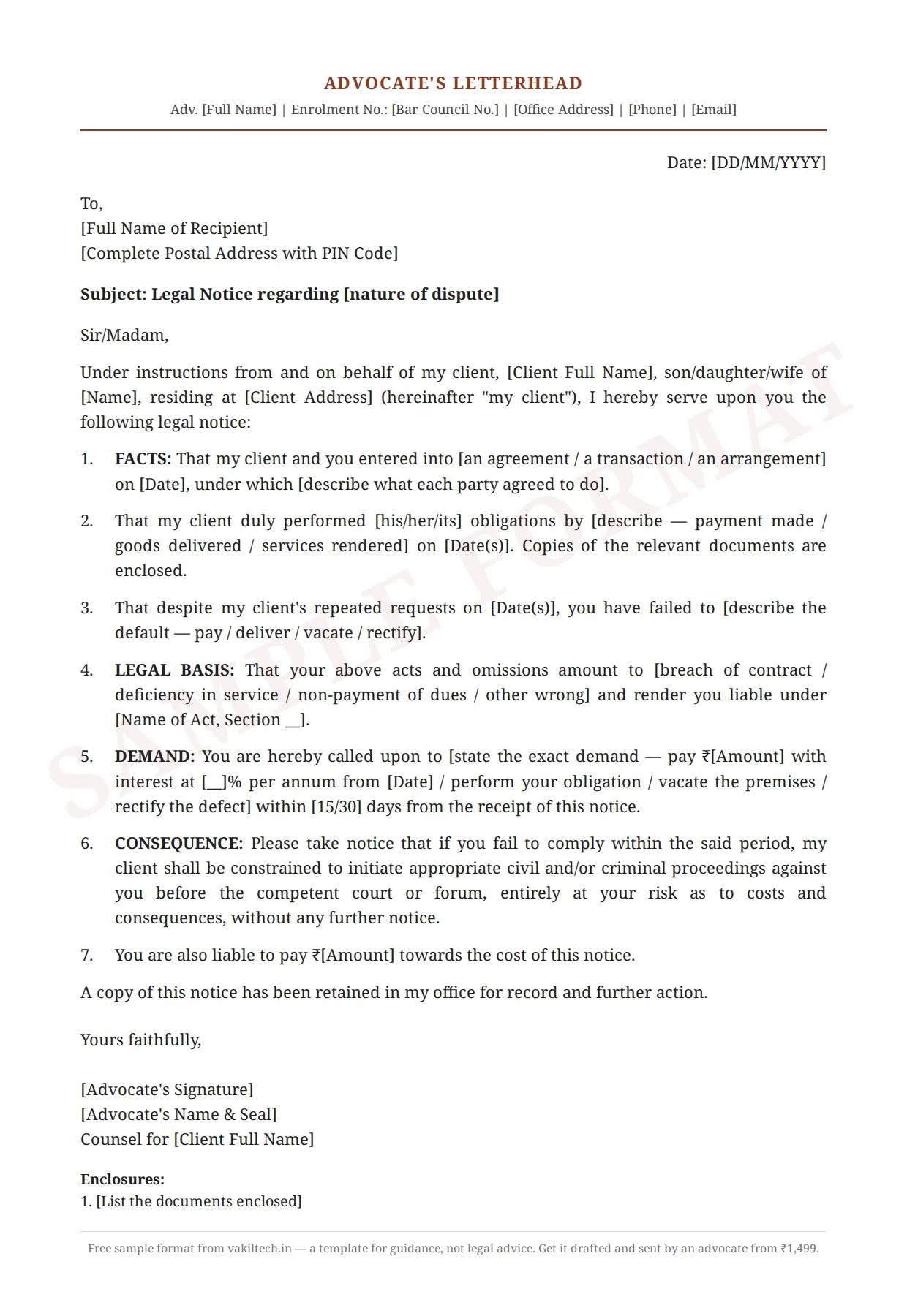
ADVOCATE'S LETTERHEAD
Adv. [Full Name] | Enrolment No.: [Bar Council No.] | [Office Address] | [Phone] | [Email]
Date: [DD/MM/YYYY]
To,
[Full Name of Recipient]
[Complete Postal Address with PIN Code]
Subject: Legal Notice regarding [nature of dispute]
Sir/Madam,
Under instructions from and on behalf of my client, [Client Full Name], son/daughter/wife of [Name], residing at [Client Address] (hereinafter "my client"), I hereby serve upon you the following legal notice:
- 1.FACTS: That my client and you entered into [an agreement / a transaction / an arrangement] on [Date], under which [describe what each party agreed to do].
- 2.That my client duly performed [his/her/its] obligations by [describe — payment made / goods delivered / services rendered] on [Date(s)]. Copies of the relevant documents are enclosed.
- 3.That despite my client's repeated requests on [Date(s)], you have failed to [describe the default — pay / deliver / vacate / rectify].
- 4.LEGAL BASIS: That your above acts and omissions amount to [breach of contract / deficiency in service / non-payment of dues / other wrong] and render you liable under [Name of Act, Section __].
- 5.DEMAND: You are hereby called upon to [state the exact demand — pay ₹[Amount] with interest at [__]% per annum from [Date] / perform your obligation / vacate the premises / rectify the defect] within [15/30] days from the receipt of this notice.
- 6.CONSEQUENCE: Please take notice that if you fail to comply within the said period, my client shall be constrained to initiate appropriate civil and/or criminal proceedings against you before the competent court or forum, entirely at your risk as to costs and consequences, without any further notice.
- 7.You are also liable to pay ₹[Amount] towards the cost of this notice.
A copy of this notice has been retained in my office for record and further action.
Yours faithfully,
[Advocate's Signature]
[Advocate's Name & Seal]
Counsel for [Client Full Name]
Enclosures:
1. [List the documents enclosed]
Download Any Format — Free PDF & Word
Tap a format name to read it on this page, or download it directly.
11 Essential Parts of a Legal Notice in India
There is no single government-prescribed format, but a well-drafted notice contains these parts. Leaving out the facts, the demand or the deadline gives the other side room to argue the notice was unclear.
- 1Letterhead — The advocate's name, address, contact details and Bar Council enrolment number — or, if you send it yourself, your own name and address.
- 2Date — Statutory deadlines (such as 30 days for a cheque bounce notice) are counted with reference to dates, so always date the notice.
- 3Recipient's details — Full name and complete postal address with PIN code. A wrong address is the most common reason a notice fails.
- 4Subject line — One clear line stating the nature of the notice, e.g. "Notice under Section 138 of the Negotiable Instruments Act, 1881".
- 5Sender's details — Full name and address of the person on whose behalf the notice is sent (the client).
- 6Statement of facts — A chronological, factual account of what happened, with dates, amounts and document references.
- 7Legal provisions — The specific Act and Section that applies — e.g. Section 138 NI Act, Consumer Protection Act 2019, Section 356 BNS.
- 8Specific demand — Exactly what you want — payment of ₹X, vacating the property, a refund. Vague demands weaken your position.
- 9Time limit — Usually 15 or 30 days from receipt. For cheque bounce under Section 138, the statute fixes it at 15 days.
- 10Consequence — A clear statement that legal proceedings will follow if the demand is not met.
- 11Signature — Signed by the advocate (with seal) or by you if you are sending it yourself. List the enclosures below.
7 Legal Notice Formats for Specific Disputes
Each format below follows the standard Indian structure with the right law already cited. Fields in square brackets [ ] are for your details. Download it, copy it, or have an advocate draft and send it for you.
Read the full format
ADVOCATE'S LETTERHEAD
Adv. [Full Name] | Enrolment No.: [Bar Council No.] | [Office Address] | [Phone] | [Email]
Date: [DD/MM/YYYY]
To,
[Full Name of Recipient]
[Complete Postal Address with PIN Code]
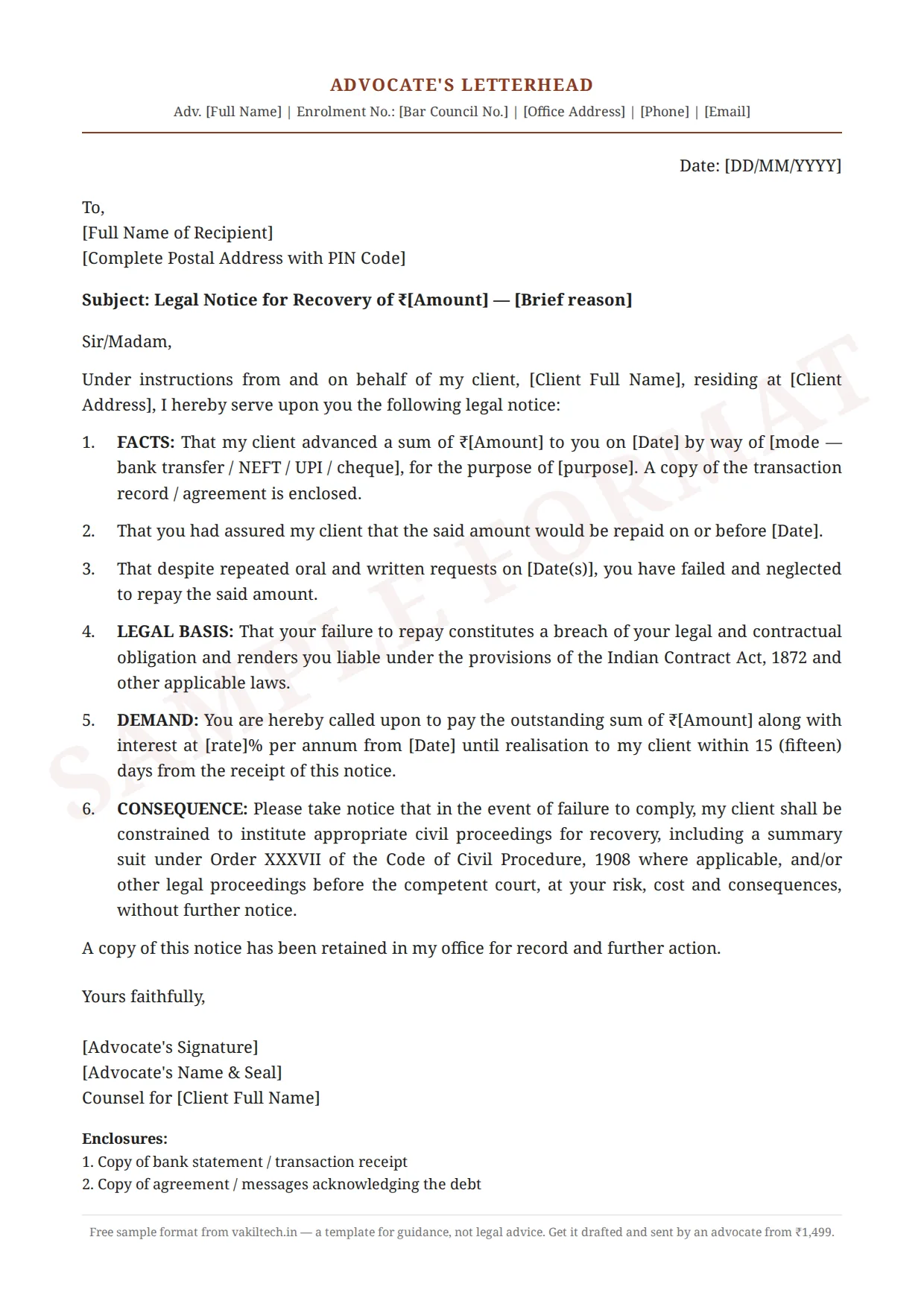
Subject: Legal Notice for Recovery of ₹[Amount] — [Brief reason]
Sir/Madam,
Under instructions from and on behalf of my client, [Client Full Name], residing at [Client Address], I hereby serve upon you the following legal notice:
- 1.FACTS: That my client advanced a sum of ₹[Amount] to you on [Date] by way of [mode — bank transfer / NEFT / UPI / cheque], for the purpose of [purpose]. A copy of the transaction record / agreement is enclosed.
- 2.That you had assured my client that the said amount would be repaid on or before [Date].
- 3.That despite repeated oral and written requests on [Date(s)], you have failed and neglected to repay the said amount.
- 4.LEGAL BASIS: That your failure to repay constitutes a breach of your legal and contractual obligation and renders you liable under the provisions of the Indian Contract Act, 1872 and other applicable laws.
- 5.DEMAND: You are hereby called upon to pay the outstanding sum of ₹[Amount] along with interest at [rate]% per annum from [Date] until realisation to my client within 15 (fifteen) days from the receipt of this notice.
- 6.CONSEQUENCE: Please take notice that in the event of failure to comply, my client shall be constrained to institute appropriate civil proceedings for recovery, including a summary suit under Order XXXVII of the Code of Civil Procedure, 1908 where applicable, and/or other legal proceedings before the competent court, at your risk, cost and consequences, without further notice.
A copy of this notice has been retained in my office for record and further action.
Yours faithfully,
[Advocate's Signature]
[Advocate's Name & Seal]
Counsel for [Client Full Name]
Enclosures:
1. Copy of bank statement / transaction receipt
2. Copy of agreement / messages acknowledging the debt
Key law: Indian Contract Act, 1872 · Summary suit under Order XXXVII CPC · Limitation: generally 3 years
Send this notice — ₹1,499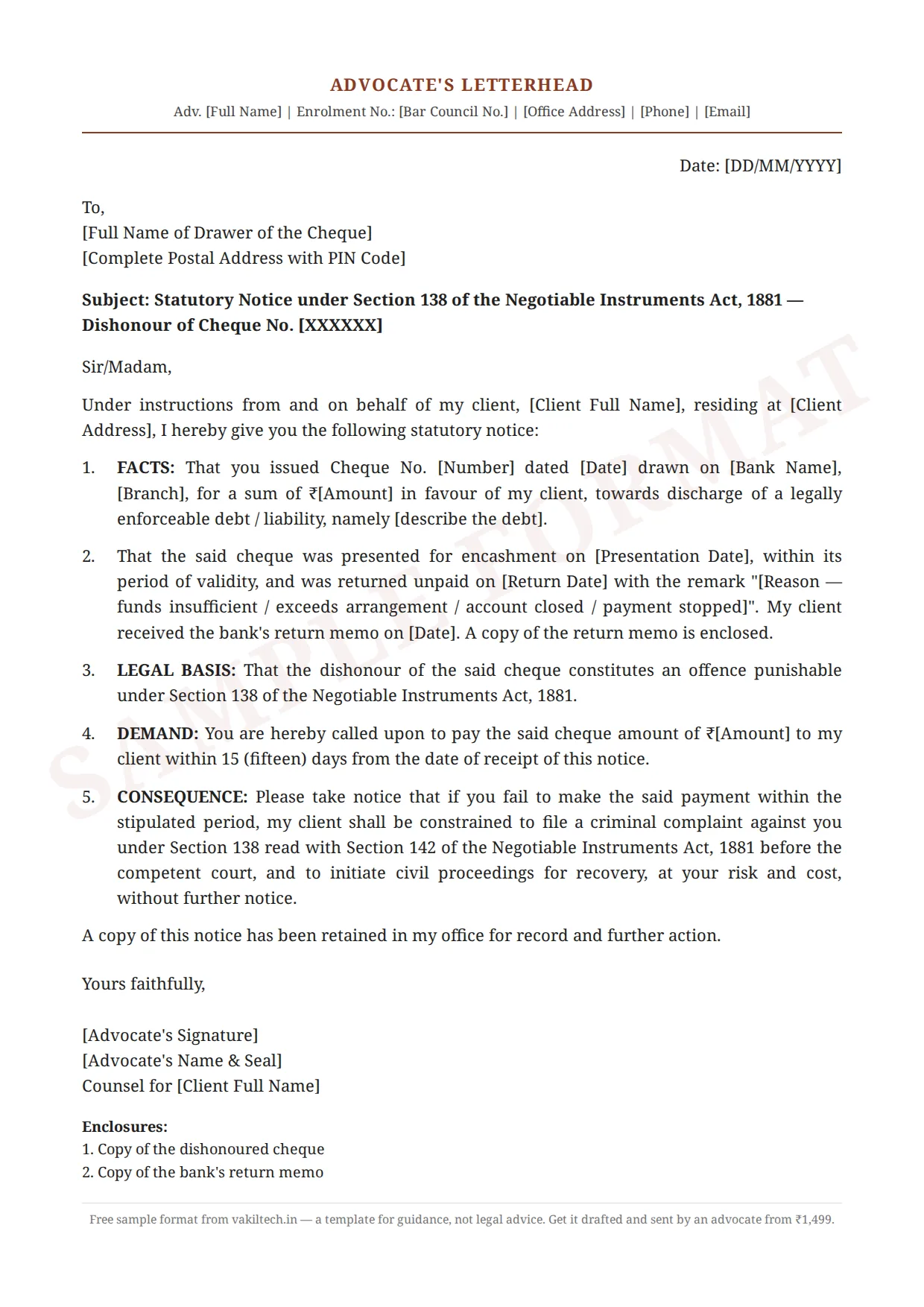
2. Legal Notice Format for Cheque Bounce (Section 138 NI Act)
30-day deadlineA statutory notice that must be sent within 30 days of receiving the bank's cheque return memo. The drawer then has 15 days from receipt to pay. If they don't, a criminal complaint under Section 138 can be filed within the following month. State the cheque amount clearly and separately from any other claim.
Read the full format
ADVOCATE'S LETTERHEAD
Adv. [Full Name] | Enrolment No.: [Bar Council No.] | [Office Address] | [Phone] | [Email]
Date: [DD/MM/YYYY]
To,
[Full Name of Drawer of the Cheque]
[Complete Postal Address with PIN Code]
Subject: Statutory Notice under Section 138 of the Negotiable Instruments Act, 1881 — Dishonour of Cheque No. [XXXXXX]
Sir/Madam,
Under instructions from and on behalf of my client, [Client Full Name], residing at [Client Address], I hereby give you the following statutory notice:
- 1.FACTS: That you issued Cheque No. [Number] dated [Date] drawn on [Bank Name], [Branch], for a sum of ₹[Amount] in favour of my client, towards discharge of a legally enforceable debt / liability, namely [describe the debt].
- 2.That the said cheque was presented for encashment on [Presentation Date], within its period of validity, and was returned unpaid on [Return Date] with the remark "[Reason — funds insufficient / exceeds arrangement / account closed / payment stopped]". My client received the bank's return memo on [Date]. A copy of the return memo is enclosed.
- 3.LEGAL BASIS: That the dishonour of the said cheque constitutes an offence punishable under Section 138 of the Negotiable Instruments Act, 1881.
- 4.DEMAND: You are hereby called upon to pay the said cheque amount of ₹[Amount] to my client within 15 (fifteen) days from the date of receipt of this notice.
- 5.CONSEQUENCE: Please take notice that if you fail to make the said payment within the stipulated period, my client shall be constrained to file a criminal complaint against you under Section 138 read with Section 142 of the Negotiable Instruments Act, 1881 before the competent court, and to initiate civil proceedings for recovery, at your risk and cost, without further notice.
A copy of this notice has been retained in my office for record and further action.
Yours faithfully,
[Advocate's Signature]
[Advocate's Name & Seal]
Counsel for [Client Full Name]
Enclosures:
1. Copy of the dishonoured cheque
2. Copy of the bank's return memo
Key law: Sections 138 & 142, Negotiable Instruments Act, 1881
Send this notice — ₹1,499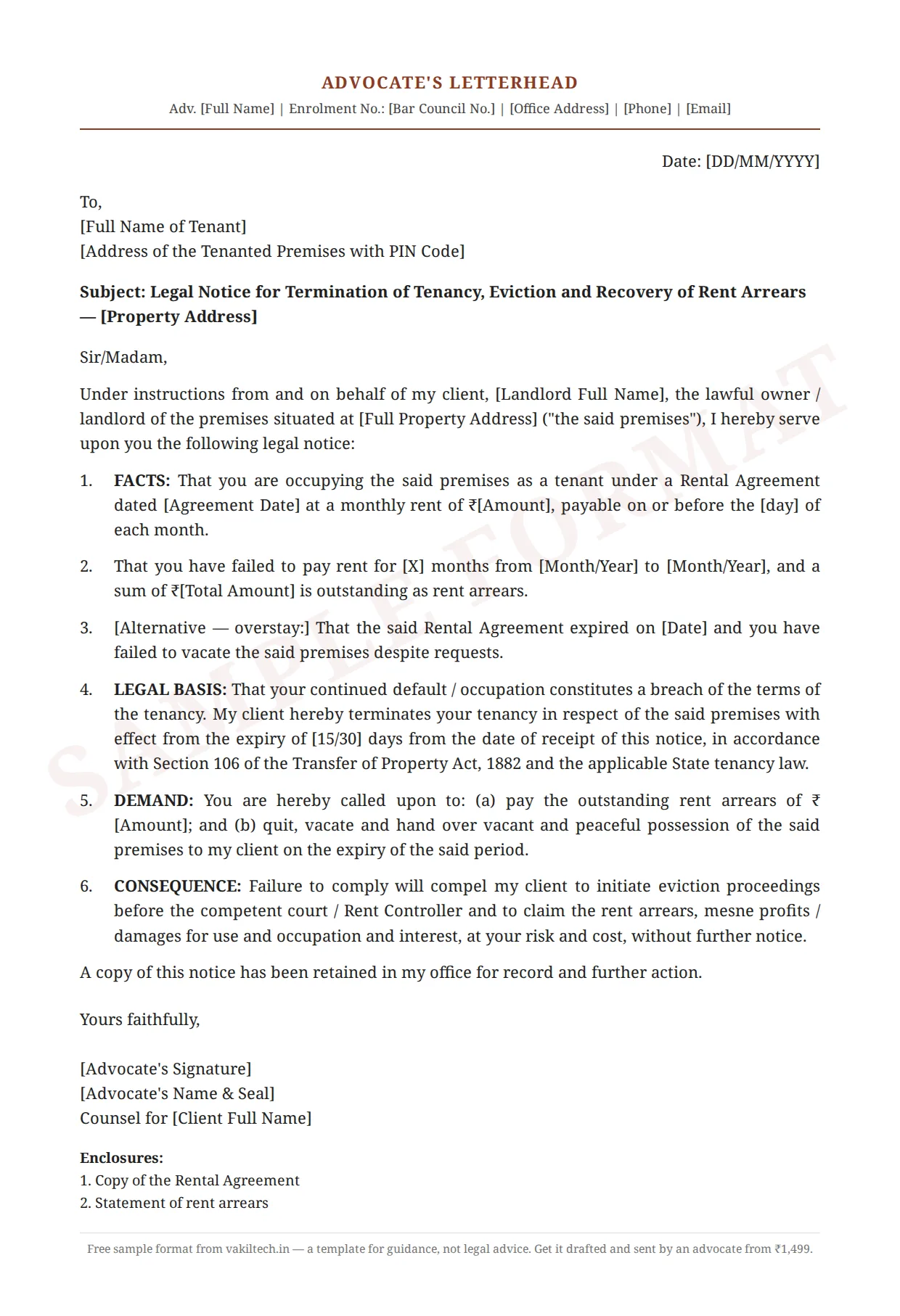
3. Legal Notice Format for Tenant Eviction
Use when a tenant is not paying rent, has overstayed after the lease ended, or has breached the rental agreement. The notice terminates the tenancy and sets a date to pay arrears and vacate. Eviction grounds and notice periods also depend on your State's rent / tenancy law.
Read the full format
ADVOCATE'S LETTERHEAD
Adv. [Full Name] | Enrolment No.: [Bar Council No.] | [Office Address] | [Phone] | [Email]
Date: [DD/MM/YYYY]
To,
[Full Name of Tenant]
[Address of the Tenanted Premises with PIN Code]
Subject: Legal Notice for Termination of Tenancy, Eviction and Recovery of Rent Arrears — [Property Address]
Sir/Madam,
Under instructions from and on behalf of my client, [Landlord Full Name], the lawful owner / landlord of the premises situated at [Full Property Address] ("the said premises"), I hereby serve upon you the following legal notice:
- 1.FACTS: That you are occupying the said premises as a tenant under a Rental Agreement dated [Agreement Date] at a monthly rent of ₹[Amount], payable on or before the [day] of each month.
- 2.That you have failed to pay rent for [X] months from [Month/Year] to [Month/Year], and a sum of ₹[Total Amount] is outstanding as rent arrears.
- 3.[Alternative — overstay:] That the said Rental Agreement expired on [Date] and you have failed to vacate the said premises despite requests.
- 4.LEGAL BASIS: That your continued default / occupation constitutes a breach of the terms of the tenancy. My client hereby terminates your tenancy in respect of the said premises with effect from the expiry of [15/30] days from the date of receipt of this notice, in accordance with Section 106 of the Transfer of Property Act, 1882 and the applicable State tenancy law.
- 5.DEMAND: You are hereby called upon to: (a) pay the outstanding rent arrears of ₹[Amount]; and (b) quit, vacate and hand over vacant and peaceful possession of the said premises to my client on the expiry of the said period.
- 6.CONSEQUENCE: Failure to comply will compel my client to initiate eviction proceedings before the competent court / Rent Controller and to claim the rent arrears, mesne profits / damages for use and occupation and interest, at your risk and cost, without further notice.
A copy of this notice has been retained in my office for record and further action.
Yours faithfully,
[Advocate's Signature]
[Advocate's Name & Seal]
Counsel for [Client Full Name]
Enclosures:
1. Copy of the Rental Agreement
2. Statement of rent arrears
Key law: Section 106, Transfer of Property Act, 1882 · State rent / tenancy law (e.g., West Bengal Premises Tenancy Act, 1997)
Send this notice — ₹1,499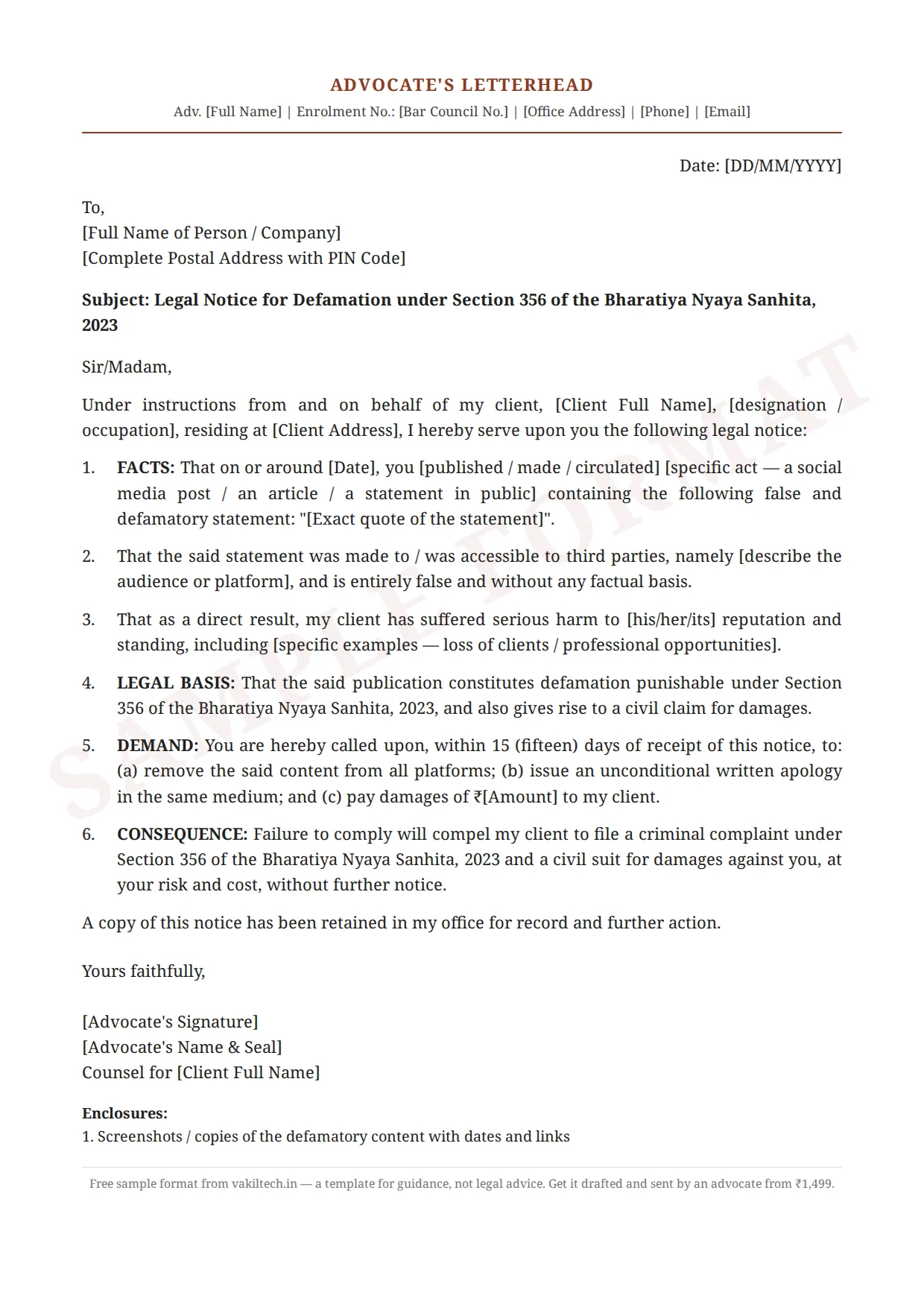
4. Legal Notice Format for Defamation (BNS Section 356)
Use when someone has made false statements — spoken, written or online — that harm your reputation. Defamation is now governed by Section 356 of the Bharatiya Nyaya Sanhita, 2023, which replaced Sections 499–500 IPC. Quote the exact statement and where it was published.
Read the full format
ADVOCATE'S LETTERHEAD
Adv. [Full Name] | Enrolment No.: [Bar Council No.] | [Office Address] | [Phone] | [Email]
Date: [DD/MM/YYYY]
To,
[Full Name of Person / Company]
[Complete Postal Address with PIN Code]
Subject: Legal Notice for Defamation under Section 356 of the Bharatiya Nyaya Sanhita, 2023
Sir/Madam,
Under instructions from and on behalf of my client, [Client Full Name], [designation / occupation], residing at [Client Address], I hereby serve upon you the following legal notice:
- 1.FACTS: That on or around [Date], you [published / made / circulated] [specific act — a social media post / an article / a statement in public] containing the following false and defamatory statement: "[Exact quote of the statement]".
- 2.That the said statement was made to / was accessible to third parties, namely [describe the audience or platform], and is entirely false and without any factual basis.
- 3.That as a direct result, my client has suffered serious harm to [his/her/its] reputation and standing, including [specific examples — loss of clients / professional opportunities].
- 4.LEGAL BASIS: That the said publication constitutes defamation punishable under Section 356 of the Bharatiya Nyaya Sanhita, 2023, and also gives rise to a civil claim for damages.
- 5.DEMAND: You are hereby called upon, within 15 (fifteen) days of receipt of this notice, to: (a) remove the said content from all platforms; (b) issue an unconditional written apology in the same medium; and (c) pay damages of ₹[Amount] to my client.
- 6.CONSEQUENCE: Failure to comply will compel my client to file a criminal complaint under Section 356 of the Bharatiya Nyaya Sanhita, 2023 and a civil suit for damages against you, at your risk and cost, without further notice.
A copy of this notice has been retained in my office for record and further action.
Yours faithfully,
[Advocate's Signature]
[Advocate's Name & Seal]
Counsel for [Client Full Name]
Enclosures:
1. Screenshots / copies of the defamatory content with dates and links
Key law: Section 356, Bharatiya Nyaya Sanhita, 2023 (criminal) · Civil suit for damages
Send this notice — ₹1,499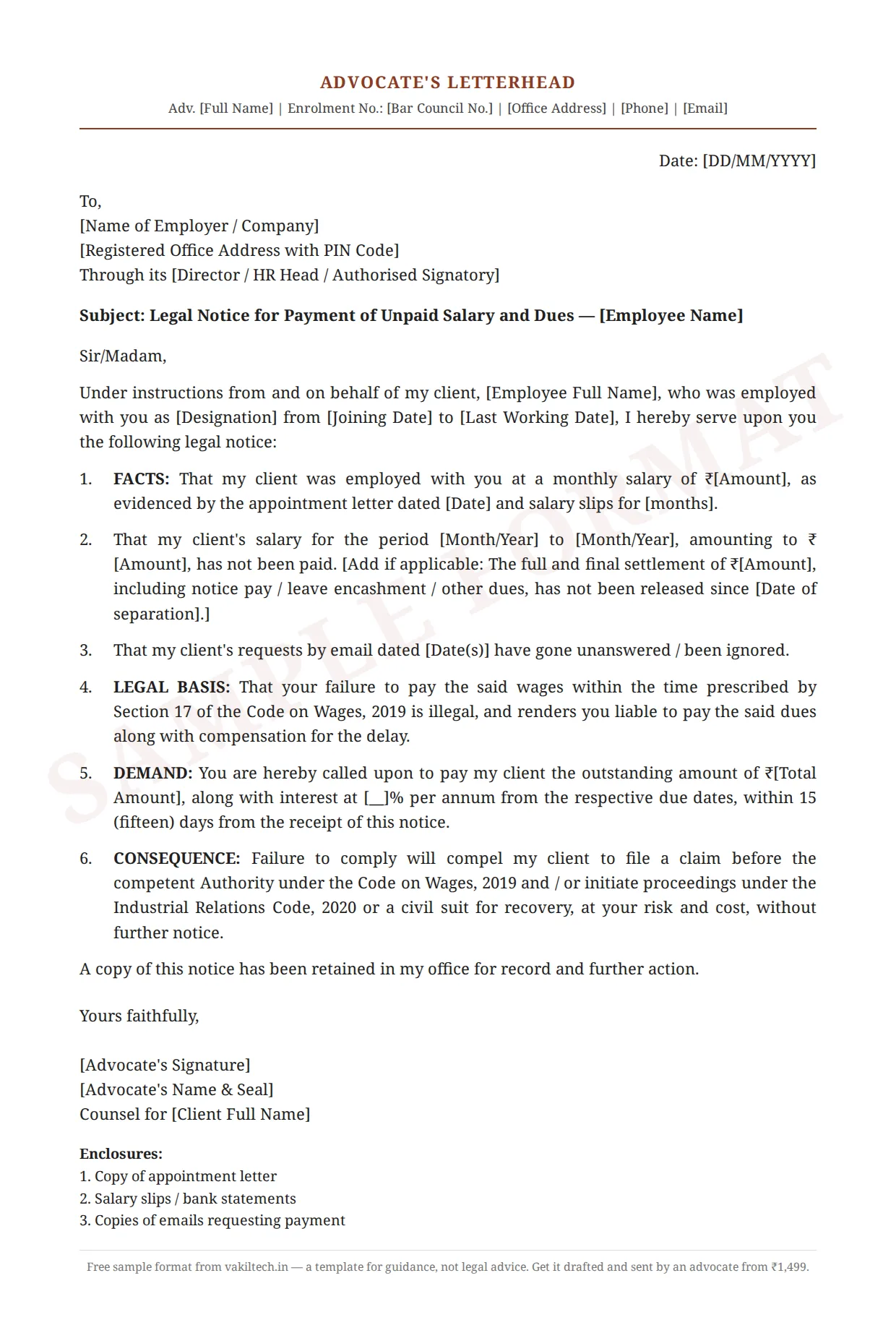
5. Legal Notice Format for Unpaid Salary
Use when an employer has not paid your salary, withheld your full and final settlement or held back statutory dues. Under the Code on Wages, 2019, final wages must be paid within two working days of your last working day. Many employers settle once they receive a formal notice.
Read the full format
ADVOCATE'S LETTERHEAD
Adv. [Full Name] | Enrolment No.: [Bar Council No.] | [Office Address] | [Phone] | [Email]
Date: [DD/MM/YYYY]
To,
[Name of Employer / Company]
[Registered Office Address with PIN Code]
Through its [Director / HR Head / Authorised Signatory]
Subject: Legal Notice for Payment of Unpaid Salary and Dues — [Employee Name]
Sir/Madam,
Under instructions from and on behalf of my client, [Employee Full Name], who was employed with you as [Designation] from [Joining Date] to [Last Working Date], I hereby serve upon you the following legal notice:
- 1.FACTS: That my client was employed with you at a monthly salary of ₹[Amount], as evidenced by the appointment letter dated [Date] and salary slips for [months].
- 2.That my client's salary for the period [Month/Year] to [Month/Year], amounting to ₹[Amount], has not been paid. [Add if applicable: The full and final settlement of ₹[Amount], including notice pay / leave encashment / other dues, has not been released since [Date of separation].]
- 3.That my client's requests by email dated [Date(s)] have gone unanswered / been ignored.
- 4.LEGAL BASIS: That your failure to pay the said wages within the time prescribed by Section 17 of the Code on Wages, 2019 is illegal, and renders you liable to pay the said dues along with compensation for the delay.
- 5.DEMAND: You are hereby called upon to pay my client the outstanding amount of ₹[Total Amount], along with interest at [__]% per annum from the respective due dates, within 15 (fifteen) days from the receipt of this notice.
- 6.CONSEQUENCE: Failure to comply will compel my client to file a claim before the competent Authority under the Code on Wages, 2019 and / or initiate proceedings under the Industrial Relations Code, 2020 or a civil suit for recovery, at your risk and cost, without further notice.
A copy of this notice has been retained in my office for record and further action.
Yours faithfully,
[Advocate's Signature]
[Advocate's Name & Seal]
Counsel for [Client Full Name]
Enclosures:
1. Copy of appointment letter
2. Salary slips / bank statements
3. Copies of emails requesting payment
Key law: Code on Wages, 2019 (replaced the Payment of Wages Act, 1936) · Industrial Relations Code, 2020
Send this notice — ₹1,499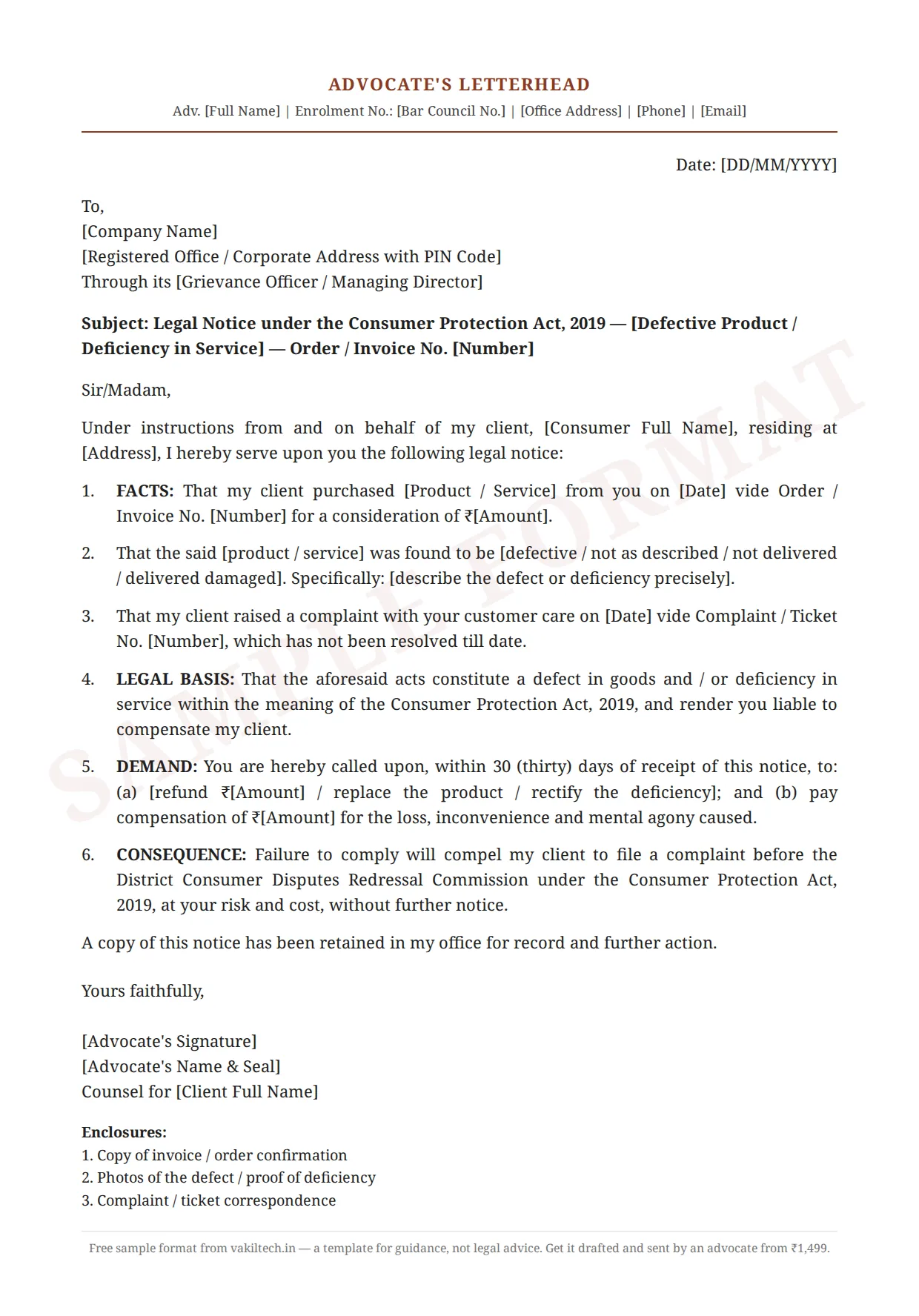
6. Legal Notice Format for Consumer Complaint
Use when a company has sold a defective product, provided deficient service or engaged in an unfair trade practice. A notice isn't mandatory before a consumer complaint, but it often gets the issue resolved and shows the Commission you gave the company a fair chance. A complaint must generally be filed within 2 years.
Read the full format
ADVOCATE'S LETTERHEAD
Adv. [Full Name] | Enrolment No.: [Bar Council No.] | [Office Address] | [Phone] | [Email]
Date: [DD/MM/YYYY]
To,
[Company Name]
[Registered Office / Corporate Address with PIN Code]
Through its [Grievance Officer / Managing Director]
Subject: Legal Notice under the Consumer Protection Act, 2019 — [Defective Product / Deficiency in Service] — Order / Invoice No. [Number]
Sir/Madam,
Under instructions from and on behalf of my client, [Consumer Full Name], residing at [Address], I hereby serve upon you the following legal notice:
- 1.FACTS: That my client purchased [Product / Service] from you on [Date] vide Order / Invoice No. [Number] for a consideration of ₹[Amount].
- 2.That the said [product / service] was found to be [defective / not as described / not delivered / delivered damaged]. Specifically: [describe the defect or deficiency precisely].
- 3.That my client raised a complaint with your customer care on [Date] vide Complaint / Ticket No. [Number], which has not been resolved till date.
- 4.LEGAL BASIS: That the aforesaid acts constitute a defect in goods and / or deficiency in service within the meaning of the Consumer Protection Act, 2019, and render you liable to compensate my client.
- 5.DEMAND: You are hereby called upon, within 30 (thirty) days of receipt of this notice, to: (a) [refund ₹[Amount] / replace the product / rectify the deficiency]; and (b) pay compensation of ₹[Amount] for the loss, inconvenience and mental agony caused.
- 6.CONSEQUENCE: Failure to comply will compel my client to file a complaint before the District Consumer Disputes Redressal Commission under the Consumer Protection Act, 2019, at your risk and cost, without further notice.
A copy of this notice has been retained in my office for record and further action.
Yours faithfully,
[Advocate's Signature]
[Advocate's Name & Seal]
Counsel for [Client Full Name]
Enclosures:
1. Copy of invoice / order confirmation
2. Photos of the defect / proof of deficiency
3. Complaint / ticket correspondence
Key law: Consumer Protection Act, 2019 · File within 2 years of the cause of action
Send this notice — ₹1,499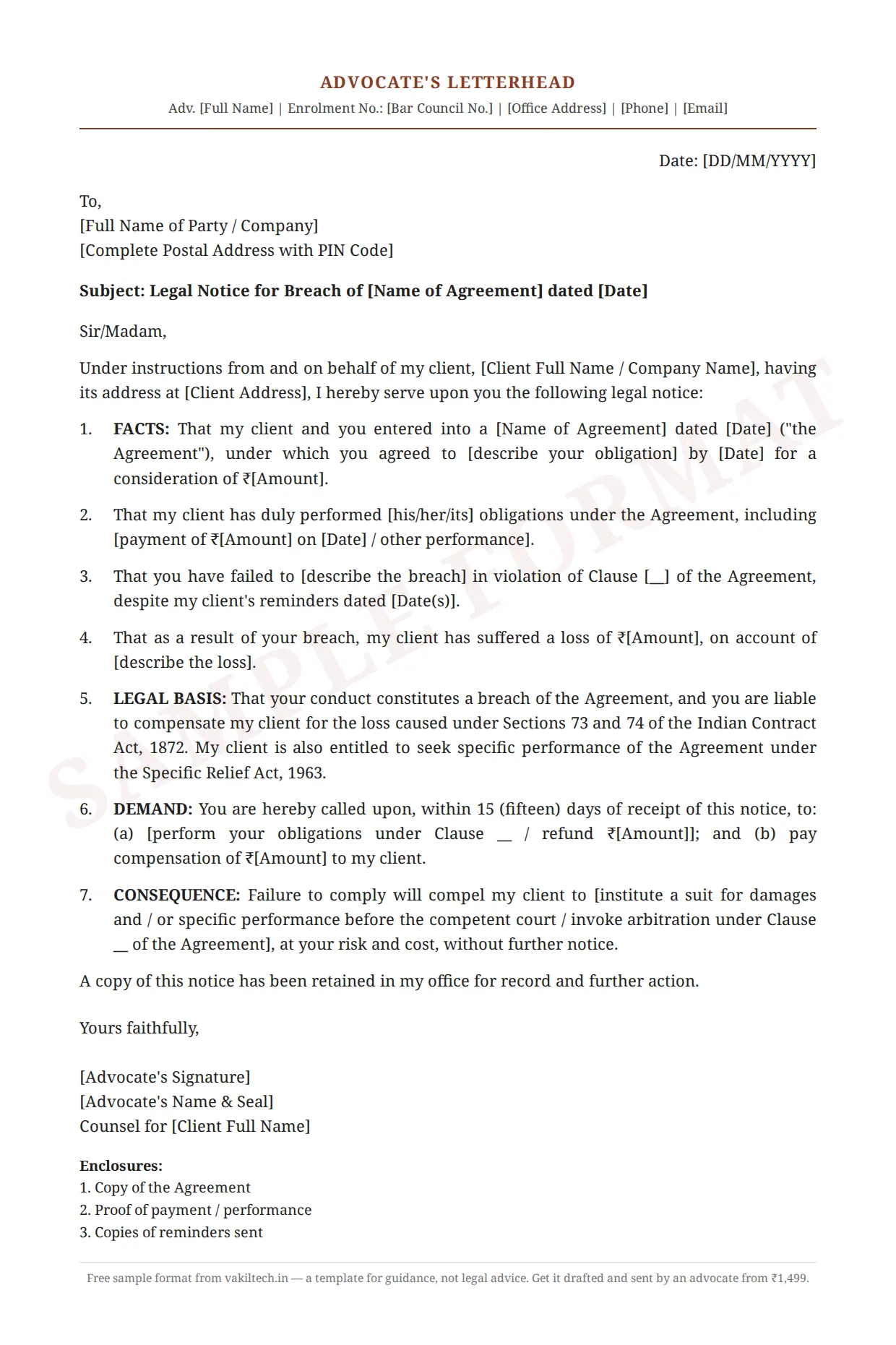
7. Legal Notice Format for Breach of Contract
Use when the other party has not performed a written or oral agreement — work not delivered, goods not supplied, payment withheld or a key term violated. Refer to the exact clause breached and quantify your loss. If the agreement has an arbitration clause, mention it.
Read the full format
ADVOCATE'S LETTERHEAD
Adv. [Full Name] | Enrolment No.: [Bar Council No.] | [Office Address] | [Phone] | [Email]
Date: [DD/MM/YYYY]
To,
[Full Name of Party / Company]
[Complete Postal Address with PIN Code]
Subject: Legal Notice for Breach of [Name of Agreement] dated [Date]
Sir/Madam,
Under instructions from and on behalf of my client, [Client Full Name / Company Name], having its address at [Client Address], I hereby serve upon you the following legal notice:
- 1.FACTS: That my client and you entered into a [Name of Agreement] dated [Date] ("the Agreement"), under which you agreed to [describe your obligation] by [Date] for a consideration of ₹[Amount].
- 2.That my client has duly performed [his/her/its] obligations under the Agreement, including [payment of ₹[Amount] on [Date] / other performance].
- 3.That you have failed to [describe the breach] in violation of Clause [__] of the Agreement, despite my client's reminders dated [Date(s)].
- 4.That as a result of your breach, my client has suffered a loss of ₹[Amount], on account of [describe the loss].
- 5.LEGAL BASIS: That your conduct constitutes a breach of the Agreement, and you are liable to compensate my client for the loss caused under Sections 73 and 74 of the Indian Contract Act, 1872. My client is also entitled to seek specific performance of the Agreement under the Specific Relief Act, 1963.
- 6.DEMAND: You are hereby called upon, within 15 (fifteen) days of receipt of this notice, to: (a) [perform your obligations under Clause __ / refund ₹[Amount]]; and (b) pay compensation of ₹[Amount] to my client.
- 7.CONSEQUENCE: Failure to comply will compel my client to [institute a suit for damages and / or specific performance before the competent court / invoke arbitration under Clause __ of the Agreement], at your risk and cost, without further notice.
A copy of this notice has been retained in my office for record and further action.
Yours faithfully,
[Advocate's Signature]
[Advocate's Name & Seal]
Counsel for [Client Full Name]
Enclosures:
1. Copy of the Agreement
2. Proof of payment / performance
3. Copies of reminders sent
Key law: Sections 73–75, Indian Contract Act, 1872 · Specific Relief Act, 1963
Send this notice — ₹1,499लीगल नोटिस का प्रारूप — Legal Notice Format in Hindi
A notice in Hindi is as valid as one in English. Use this format when the recipient reads Hindi more comfortably — it removes any later claim that they could not understand the notice.
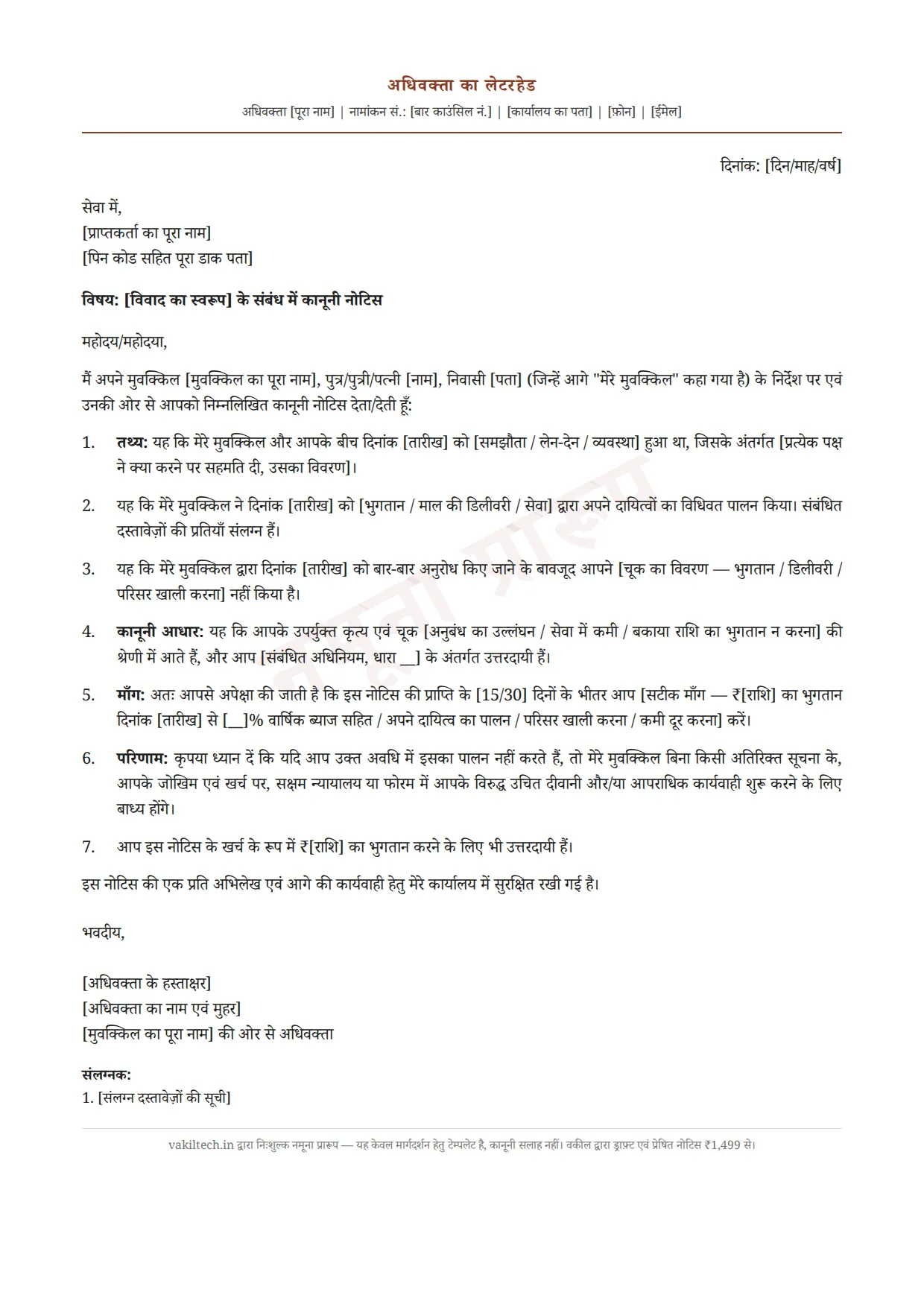
हिंदी में सामान्य लीगल नोटिस प्रारूप
हिंदीहिंदी में भेजा गया लीगल नोटिस पूरी तरह मान्य है। यदि प्राप्तकर्ता अंग्रेज़ी नहीं समझता, तो उसकी भाषा में नोटिस भेजना बेहतर है, ताकि वह बाद में यह न कह सके कि उसे नोटिस समझ नहीं आया। नीचे दिया गया सामान्य प्रारूप किसी भी विवाद के लिए इस्तेमाल किया जा सकता है — कोष्ठक [ ] में अपना विवरण भरें।
पूरा प्रारूप पढ़ें
अधिवक्ता का लेटरहेड
अधिवक्ता [पूरा नाम] | नामांकन सं.: [बार काउंसिल नं.] | [कार्यालय का पता] | [फ़ोन] | [ईमेल]
दिनांक: [दिन/माह/वर्ष]
सेवा में,
[प्राप्तकर्ता का पूरा नाम]
[पिन कोड सहित पूरा डाक पता]
विषय: [विवाद का स्वरूप] के संबंध में कानूनी नोटिस
महोदय/महोदया,
मैं अपने मुवक्किल [मुवक्किल का पूरा नाम], पुत्र/पुत्री/पत्नी [नाम], निवासी [पता] (जिन्हें आगे "मेरे मुवक्किल" कहा गया है) के निर्देश पर एवं उनकी ओर से आपको निम्नलिखित कानूनी नोटिस देता/देती हूँ:
- 1.तथ्य: यह कि मेरे मुवक्किल और आपके बीच दिनांक [तारीख] को [समझौता / लेन-देन / व्यवस्था] हुआ था, जिसके अंतर्गत [प्रत्येक पक्ष ने क्या करने पर सहमति दी, उसका विवरण]।
- 2.यह कि मेरे मुवक्किल ने दिनांक [तारीख] को [भुगतान / माल की डिलीवरी / सेवा] द्वारा अपने दायित्वों का विधिवत पालन किया। संबंधित दस्तावेज़ों की प्रतियाँ संलग्न हैं।
- 3.यह कि मेरे मुवक्किल द्वारा दिनांक [तारीख] को बार-बार अनुरोध किए जाने के बावजूद आपने [चूक का विवरण — भुगतान / डिलीवरी / परिसर खाली करना] नहीं किया है।
- 4.कानूनी आधार: यह कि आपके उपर्युक्त कृत्य एवं चूक [अनुबंध का उल्लंघन / सेवा में कमी / बकाया राशि का भुगतान न करना] की श्रेणी में आते हैं, और आप [संबंधित अधिनियम, धारा __] के अंतर्गत उत्तरदायी हैं।
- 5.माँग: अतः आपसे अपेक्षा की जाती है कि इस नोटिस की प्राप्ति के [15/30] दिनों के भीतर आप [सटीक माँग — ₹[राशि] का भुगतान दिनांक [तारीख] से [__]% वार्षिक ब्याज सहित / अपने दायित्व का पालन / परिसर खाली करना / कमी दूर करना] करें।
- 6.परिणाम: कृपया ध्यान दें कि यदि आप उक्त अवधि में इसका पालन नहीं करते हैं, तो मेरे मुवक्किल बिना किसी अतिरिक्त सूचना के, आपके जोखिम एवं खर्च पर, सक्षम न्यायालय या फोरम में आपके विरुद्ध उचित दीवानी और/या आपराधिक कार्यवाही शुरू करने के लिए बाध्य होंगे।
- 7.आप इस नोटिस के खर्च के रूप में ₹[राशि] का भुगतान करने के लिए भी उत्तरदायी हैं।
इस नोटिस की एक प्रति अभिलेख एवं आगे की कार्यवाही हेतु मेरे कार्यालय में सुरक्षित रखी गई है।
भवदीय,
[अधिवक्ता के हस्ताक्षर]
[अधिवक्ता का नाम एवं मुहर]
[मुवक्किल का पूरा नाम] की ओर से अधिवक्ता
संलग्नक:
1. [संलग्न दस्तावेज़ों की सूची]
कानून: अपने विवाद पर लागू अधिनियम एवं धारा का उल्लेख करें
वकील से नोटिस भिजवाएँ — ₹1,499Demand Notice Format — Is It Different?
A demand notice is a legal notice whose main purpose is to demand payment or performance. For most disputes you can use the general format or the money recovery format above: state the exact amount, how it became due, and a deadline to pay.
A few demand notices have contents fixed by law:
- Cheque bounce — the Section 138 NI Act notice must demand the cheque amount within 30 days of the return memo (see the cheque bounce format).
- Insolvency (IBC) — an operational creditor's demand notice under Section 8 of the Insolvency and Bankruptcy Code, 2016 is issued in the prescribed Form 3 or Form 4.
- Bank loan recovery — lenders issue a demand notice under Section 13(2) of the SARFAESI Act, 2002 before acting against secured assets.
Legal Notice Letterhead Format
An advocate's letterhead sits at the top of the first page and identifies who is sending the notice. It usually carries:
ADV. [FULL NAME]
[Qualification, e.g. B.A. LL.B.] · Enrolment No. [State Bar Council / Number / Year]
[Chamber / Office Address] · [Phone] · [Email]
Sending the notice yourself? Letterhead isn't required — put your own name, address and contact details at the top, write in the first person ("I hereby call upon you…") and sign it yourself. It is still a valid notice.
7 Common Mistakes That Weaken a Legal Notice
These mistakes show up again and again in self-drafted notices:
- Wrong recipient address. If the notice can't be delivered, you may have to start again — and statutory deadlines (like the 30-day cheque bounce window) may run out.
- Citing the wrong law. An inapplicable section weakens your case and hands the other side an easy objection.
- Vague demands. "Pay me the money you owe" is not a demand. "Pay ₹85,000 advanced on 12 March 2026 via NEFT (UTR No. XXXXX)" is.
- No compliance deadline. Without a specific deadline, the other side can claim they were still considering your request when you filed the case.
- Factual inconsistencies. Facts that contradict your own documents (a different amount or date) will be used against you in court.
- Sending by ordinary post. Ordinary post has no delivery proof. Always use Speed Post or RPAD.
- Emotional or threatening language. Keep it professional and factual. Threats can invite a defamation or criminal intimidation counter-claim.
How to Send a Legal Notice — Valid Modes in India
The mode of delivery matters as much as the content:
| Mode | Legal standing | Recommended? |
|---|---|---|
| Speed Post | Strong — tracked proof of delivery; courts generally presume delivery | Yes ✓ |
| RPAD | Strong — signed acknowledgement card comes back to you | Yes ✓ |
| Accepted as evidence, especially where parties already corresponded by email | Supplement | |
| Accepted in several court rulings, but not uniformly | Supplement | |
| Ordinary post / courier | Weak — no reliable proof of delivery | No ✗ |
| Hand delivery | Valid if the recipient signs an acknowledgement | With caution |
Best practice: send by Speed Post and email on the same day. More on sending a legal notice by email or WhatsApp. vakiltech dispatches every notice by Speed Post and gives you the tracking number.
Rather Not Draft It Yourself?
A self-drafted notice with the wrong law or a vague demand can weaken your case. A vakiltech advocate drafts your notice with the correct provisions and sends it by Speed Post — ₹1,499, drafted within 24 hours.